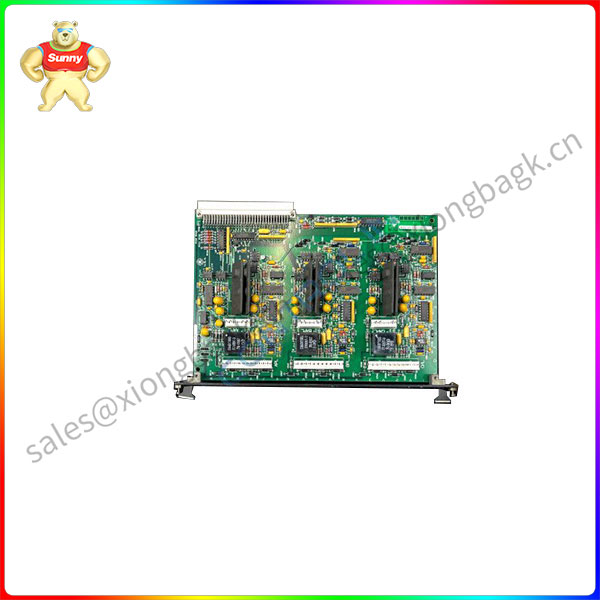
Model IS200ECTBG1A
Brand GE
Category, exciter contact terminal board
The IS200ECTBG1A, part of the Exciter controller family EX2100, is an exciter Contact terminal board (ECTB). Its main function is to support excitation contact input and output, with the ability to control relay contact output and user contact input. The model is labeled 1A and can only operate in redundancy mode 1.
An exciter contact terminal board is a board-type device used to connect an exciter to a controller.
IS200ECTBG1A exciter contact terminal board is usually made of copper, with high conductivity, high strength, wear resistance and other characteristics. It realizes the transmission and control of the excitation current by connecting the terminals of the exciter and the controller, and is one of the indispensable components in the excitation system.
The exciting current is not the current that is excited.
IS200ECTBG1A excitation current is the current flowing through the rotor of a synchronous motor, which is the current used to generate a magnetic field, not the current that is excited out. Any current will produce a magnetic field, but an exciting current is a current that is specifically used to produce a working magnetic field.
There is a difference between excitation resistance and magnetoresistance.
IS200ECTBG1A excitation resistance is the resistance that excites the magnetic field, which is jointly determined by the coil and the magnetic circuit. Magnetoresistance is the obstruction of the magnetic flux through the magnetic circuit, expressed in Rm, and it has no relationship with the coil.
The IS200ECTBG1A controller is a master device that changes the wiring of the main circuit or control circuit and changes the resistance value in the circuit to control the start, speed regulation, braking and reverse of the motor in accordance with the predetermined sequence.
The controller is composed of program counter, IS200ECTBG1A instruction register, instruction decoder, timing generator and operation controller, which is the "decision mechanism" of issuing commands, that is, to complete the coordination and command of the operation of the whole computer system.


